
Orchid Socrates
Voice networks still run on manual effort and a few experts
Alarm floods, manual hunts
One alarm means hours across CMS, BAM, logs and packet captures.
Agents triage in minutes
Root cause found from live evidence; ticket raised, right team alerted.
Slow, manual maintenance
Upgrades and patches go node by node, often after hours.
Verified workflows
Dry run, approve, execute and roll back, the same way every time.
Know-how in a few heads
How fast an issue is fixed depends on who is on shift.
Expertise captured once
Runbooks and playbooks become agents and workflows anyone can run.
Operations that don't scale
Every new customer adds load on the NOC and engineering.
Operations that scale
Agents take the routine work, so teams focus on
growth.
Orchid Socrates
Lifecycle & Provisioning
Automated deployment, patching, and onboarding workflows
Triage and RCA
Faster root cause, backed by evidence
Observability
Build agents for KPI, CDR, and alarm monitoring
Service Desk & NOC Automation
Tickets resolved through approved workflows
Vulnerability Management
CVE exposure tracked, prioritized and patched
Fraud & Deepfake Detection
Anomalous calls and synthetic voices flagged in real time
TM Forum autonomous network levels
Level 0
Completely manual
Level 1
Assisted operations and maintenance
Level 2
Partial autonomous network
Level 3
Conditional autonomous network
Level 4
Highly autonomous network
Level 5
Fully autonomous network
Agents do the work.
Operators stay in command.
Orchid Socrates is the workflow and agentic operations platform for Orchid SBC and Collab platforms. It combines the proven, deterministic DevOps workflows we already trust with AI agents grounded in live network data, delivered through one console for deployment, patching, provisioning, operations, monitoring and issue resolution.
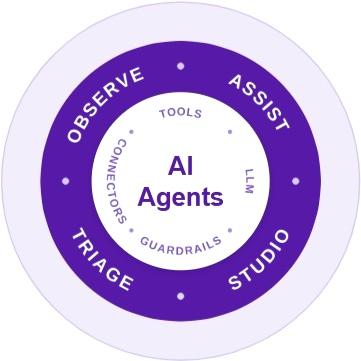
1 MONITOR
Observe
2 UNDERSTAND
Assist
3 PLAN
Studio
4 FIX
Triage
Platform Capabilities
Large language model
A model that reads, reasons and writes. It is the brain, but on its own it knows nothing about our customers' networks.
AI agent
A model given a goal, a set of tools and a loop: gather context, decide, act, check, and repeat until done.
Tools and MCP
Model Context Protocol is a standard plug that lets agents read CMS, BAM and logs, and call approved workflows. Nothing else is exposed.
Grounded knowledge (RAG)
Before answering, the agent looks up our docs, runbooks and KB, so answers cite sources instead of guessing.
Workflows
Deterministic, reviewed automation: the Ansible, Terraform and CLI scripts we already trust. Agents choose them; they don't rewrite them.
Human in the loop
People approve anything that changes the network. Autonomy is earned, one action type at a time.
What powers Orchid Socrates
FOUNDATION
AGENTS: BUILD AND RUN
WORKFLOWS: DESIGN AND EXECUTE
Grounded knowledge (RAG)
- Discovered CMS, customers, nodes and trunks
- Topology, version, health at a glance
- Selection sets context for agents, workflows
Agent Builder Studio
- Define goal, instructions, triggers and tools
- Choose data sources, LLM, guardrails
- Test against scenarios, then publish versions
Workflow Studio
- Design visually or from plain-language intent
- Mix DevOps steps, agent steps and approvals
- Templates, versions and dry run
DevOps Pipelines
- Existing scripts, runbooks and CI/CD
- Upgrades, patching and provisioning at scale
- Scheduler and run history
Agents
- Service Desk, Assist, Triage and custom agents
- Run on demand, on a schedule or on events
- Every action traced and auditable
Execution Environment
- Runs workflows and agents on any trigger
- Live progress: pause, abort, roll back
- Isolated runners, cloud or on-prem
NOC Automation Service Desk Agent
1 Observe events
CMS
cms.get_alarms
cms.query_kpis
2 Collect evidence
BAM · CMS · SBC
cms.get_config_diff
sbc.sip_trace
Service Desk Agent
Email · Teams
OBJECTIVE
INSTRUCTIONS
HOW IT WORKS
Observe
Detect
Collect
Triage
Ticket
INSIDE
Tools
MCP, governed
LLM
model gateway
Knowledge Base
runbooks, tickets
NOC Playbook
checks, severity
Connectors
CMS, BAM, Jira
3 Create ticket
Jira
jira.create_issue
jira.update_issue
4 Notify the operator
Email · Teams
teams.notify
Value for customers and operations teams
For customers
- Faster resolution, fewer outages
- Increased uptime
- Quicker detection of anomalies
For operations teams
- Fewer escalations
- Faster upgrades and patching
- Senior engineers' know-how captured as workflows
- Time back for higher-value engineering