
Mauritius Telecom
Overview

Mauritius Telecom, established in 1992, is the leading telecommunications provider in Mauritius and a key enabler of the country’s digital-economy development. Its service portfolio spans fixed-line, mobile, broadband, IPTV, fintech, cloud, and data centre services, giving the operator a broad and strategically important role in the national communications landscape.
- Headquarters: Telecom Tower, Edith Cavell Street, Port Louis, Mauritius
- Company size: 2,000+ employees
- Market position: Leading telecom provider in Mauritius
- Primary Market Context: Africa and Asia
- Key services: Fixed, mobile, broadband, television, fintech, cloud, and data center services
A national-scale operator needed an interconnect platform that could handle migration risk today and future service evolution tomorrow.
SBC Deployment Challenges
Replacing a highly interconnected legacy voice environment without disrupting service
Business Challenges & Evolution
- Migrate from legacy NGN (supporting both E1 and SIP) to a modern SBC platform.
- Preserve customer-facing service continuity throughout the transition.
- Securely handle high traffic volumes across the network.
Technical Challenges
- Analyze large numbers of interdependencies in the legacy configuration.
- Replicate routing policies and trunk behavior accurately.
- Maintain interoperability for interconnect and IGW operations.
Project Pressure
- Domestic and international carriers had to be migrated using a Big Bang approach.
- Existing call flows and routing behavior had to remain intact.
- Errors in cutover planning could have impacted multiple live services.
Key Requirements
What the new interconnect platform had to achieve
Requirement Blocks
Security and control
- Robust SBC security.
- Secure management of high traffic volumes.
- Reliable control across the interconnect environment.
Integration and interoperability
- Easy integration with existing systems.
- Resolution of interoperability challenges for IGW operations.
- Compatibility with current network and service architecture.
Billing and operations
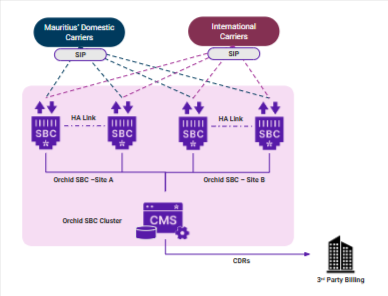
- Support for custom CDR output based on billing-vendor requirements.
- Smooth integration with the MT billing environment.
- Operational productivity and reduced service risk.
Expected Outcome
- Mitigate customer risk
- Increase productivity
- Maintain competitive edge in a changing telecom market
What Made This Deployment Different
Professional Services & Support — Beyond a Standard SBC Delivery
This was not just an SBC deployment; it was a controlled migration of a complex legacy interconnect environment into a future-ready platform.
Migration Complexity
- Like-for-like migration from legacy NGN to Orchid SBC.
- Per-trunk mapping of trunk group IDs to preserve call flows.
- Detailed analysis of SIP trunks, IP settings, SIP specifications, and routing policies.
Billing and Interoperability Work
- MT Billing required 66 specific fields from the SBC-generated records.
- Orchid SBC is capable of generating more than 400 SDR fields, but the integration had to be tailored to legacy parser expectations.
- Additional timestamp-format enhancement was introduced to match billing requirements.
Troubleshooting and Cutover Protection
- VLAN-tagged traffic on the HA platform required joint debugging with the MT network team.
- Some SIP traffic IP assignments using /32 or /31 subnet masks had to be reviewed and adapted for proper operation.
- A phased validation approach was used before final Big Bang migration to reduce deployment risk.
Deployment Results and Business Impact
Current Success
- Seamless cutover from Legacy NGN to Orchid SBC.
- Existing service behavior and routing logic preserved.
- Reliable platform for complex telecom interconnect services.
Platform Benefits & Future Value
- Simplified routing and management.
- Handles high-density traffic and supports growth across multiple nodes.
- Scalable platform for future interconnect and IGW expansion.
- Strong base for future fraud-tool integration working alongside the SBC.
Business Impact
- Improved security foundation for voice interconnect services
- Stronger system integrity and customer data protection
- Reduced infrastructure complexity on a single platform
Redefining flexibility in real-time communications.
Cataleya engineers Session Border Controllers and real-time communications software that scale with our customers — not the other way around.
Address
8 Wilkie Road #03-01 Wilkie Edge 228095, Singapore
Online
info@cataleya.com
www.cataleya.com
Our service desk will look after your deployments 24/7
Contact Us for a Demo